
Bigscreen Beta remains a low-key social VR alternative, but with an uncertain future
Bigscreen has long been lauded for its shared virtual theater experience, engendering a small, but dedicated following.


I’m not the biggest social VR user. I get on a social VR kick a few times a year, usually rotating between VRChat, Horizon Worlds and Bigscreen Beta. But it’s Bigscreen where I often find myself spending the most time.
Nowadays you may know the brand better for their Bigscreen Beyond ultralight tethered PCVR headsets, but the Bigscreen app is how the company first hit the VR scene, delivering shared virtual theaters for users to watch video content together, including in 3D.
While the shared theater experience can also be achieved in VRChat worlds like the popular Popcorn Palace, the prospect of popping into an app primarily dedicated to that experience, with users always streaming something (movies, sports, news, YouTube, etc.), it can be fun to see what people are watching — or discussing.
For as much as Bigscreen is built around the theater experience, “chat” is often the leading public room topic. Sometimes the screen becomes a centerpiece as users collectively recommend web pages and videos to promote discussion, or an afterthought entirely as the room succumbs to a cacophony of debate.
The most common chat rooms I see include casual hangouts, loaded political arguments, faith-based discussion groups and even structured debates, complete with queues and timed speaking opportunities.
As you’d expect on the Internet, many of these discussions aren’t exactly constructive. Shouting matches are typical and trolls are pervasive. For the introverted, it can be easy to turn into a wall flower, watching from the sidelines hoping folks run out of steam so you can get a word in edgewise.
While Bigscreen lacks a massive pool of official and user-uploaded avatars like in VRChat, the admittedly cartoonish avatars are still sufficient as VR rigs for human expressiveness. You can really embody chatting with strangers on the Internet as you watch them shake their heads disapprovingly or bury their faces in their hands.
The environment offerings are likewise limited, though Bigscreen did add support for user-created environments in 2024. They’re a far cry from the expansive, creative worlds of VRChat, but these smaller spaces are often better suited for chat rooms anyway.
One of the most popular is the modern apartment, featuring curved couches wrapping around a sunken living room, facing a screen and nearby armchair, often occupied by the host. The layout is conducive to a clear delineation between facilitator and participant. Some hosts seem to thrive on this architecturally enforced power dynamic, performing the role of teacher, though with the ability to kick or ban “students” on a whim.
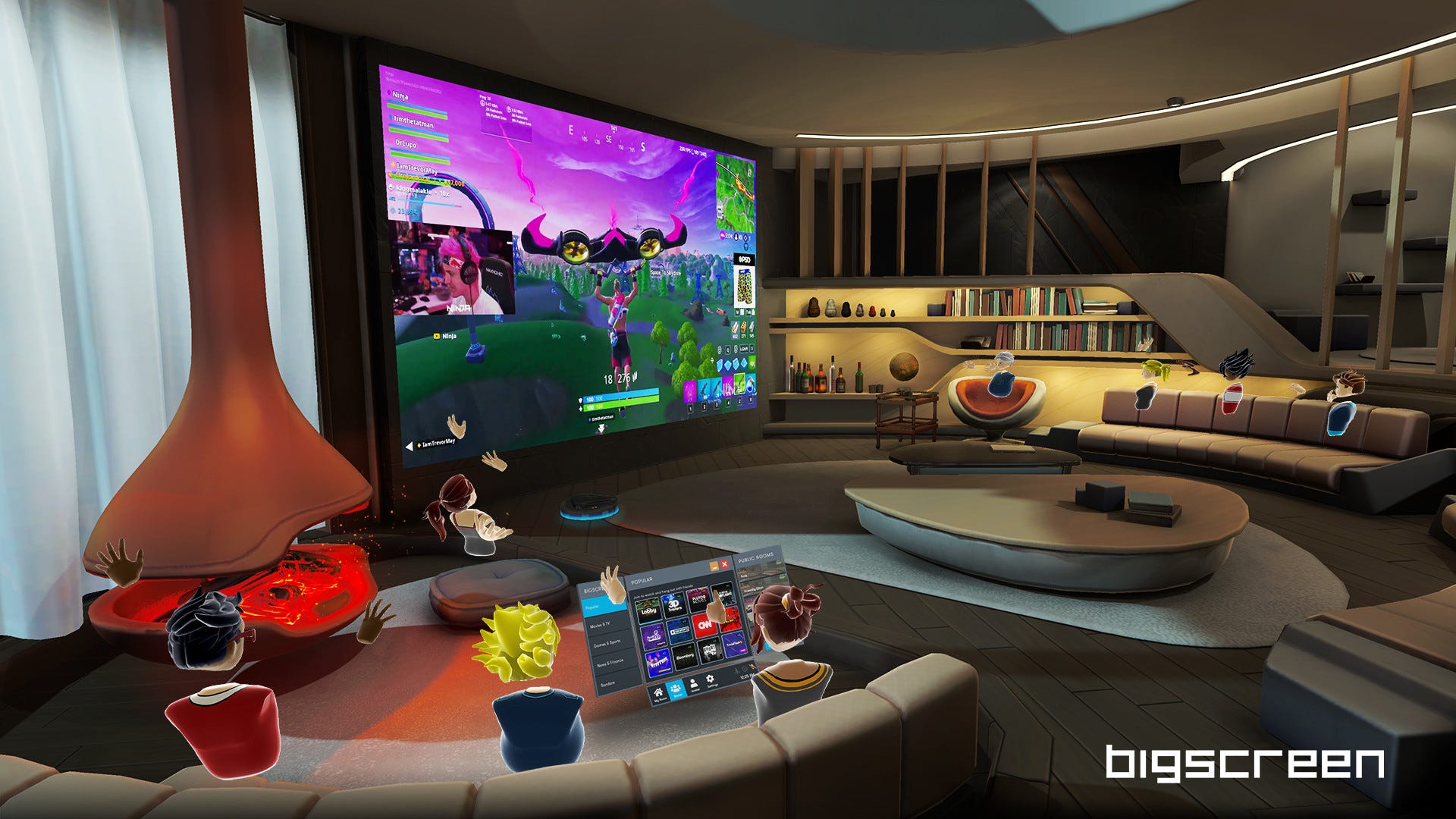
In a way, the low-fidelity aesthetics and organic emergence of chat rooms harkens back to the old Internet, where early netizens often made due with what limited virtual tools and spaces they had at their disposal to carve out social spaces.
It’s both refreshing and challenging actually having to embody your speech. I grew up on social games ranging from MMOs like Dark Age of Camelot to more casual experiences like Habbo Hotel. Early social media for me meant traditional message boards, while today I gravitate toward their modern day, all-encompassing equivalent, Reddit. This resulted in a predilection for text-based chat, especially for topics that rarely feature in my everyday, in-person communications with friends and family.
Actually having to use your own voice and gestures is far more personal and vulnerable. Suddenly topics I’m used to only writing about I’m tasked with trying to articulate on the fly, grasping for facts, figures and concepts. Even without face or eye tracking, it can be easy to give away your uncertainty or frustration with a blank stare or involuntary gesticulation.
At times, it can be a truly uncomfortable, grating and embarrassing experience. I find myself wondering why I bother. It can feel like an exercise in collective navel gazing, as each of us tries to elucidate on our pet theories and trivia, hearing each other out only as long as it takes to get to the next opportunity to interject. What’s more, you’re often contending with trolls trying to sour other people’s good faith efforts.
But under the right conditions, with the right conversation partners, and with your own emotional and intellectual states in check, there’s a real opportunity to share perspectives and information to each other’s mutual benefit, with a genuine interest in education and collaboration.
These Goldilocks chat rooms are few and far between, but I’ve still had enough of them to keep me coming back. You never know when you’ll find the next one, or if you’ll unwittingly find yourself stuck in a room with someone trying to indoctrinate you into their favorite conspiracy theories.
At a time when “Dead Internet Theory” is trending and our traditional social media are being flooded with bots and AI-generated slop, at least it’s easier in social VR to feel reassured of a user’s authenticity when you can hear their voice and see their mannerisms.
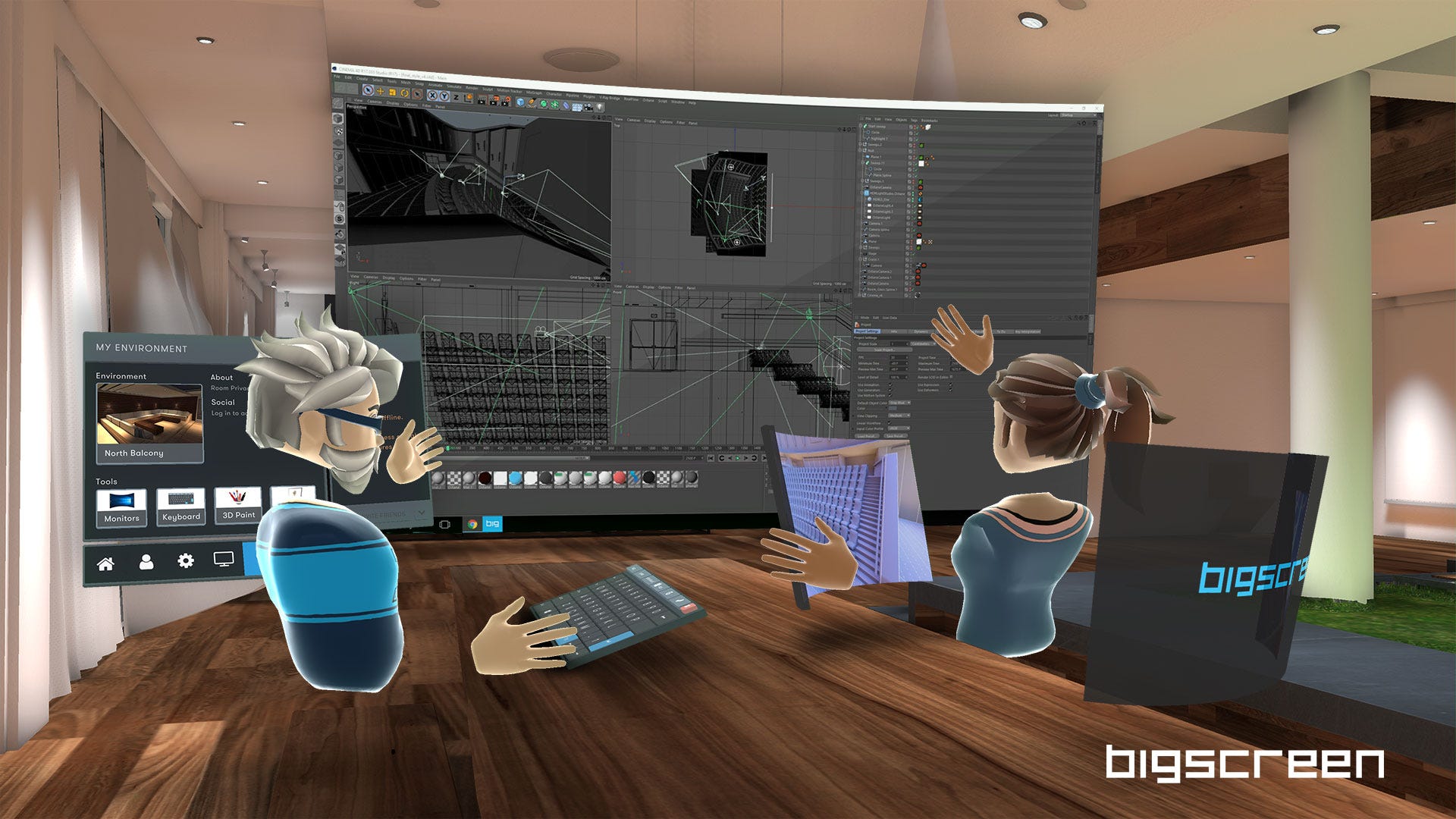
As much as I personally enjoy dipping into Bigscreen for the screens and company, there aren’t a whole lot of us who do. It’s unclear what the developer has in mind at this point, especially with the growth of their headset business.
The roadmap for Bigscreen Beta appears nonexistent. Scanning through Bigscreen’s blog, the most recent post I could find related to the app was from June 2024, tucking the aforementioned user-created environments announcement into a post headlined by Bigscreen Beyond production news.
Further, Bigscreen’s Steam store page includes “coming soon” features like a friend system (already implemented) and promises “more movie studio partnerships,” of which there’s been no news.
At one time, there was a catalogue of 3D movies you could rent, but it was discontinued in 2024.
“We have currently paused sales of our current rental catalogue and are working to bring new movie rental content to the app in the future,” reads a two-year-old Reddit comment, claimed to be from a Bigscreen support email.
So far nothing’s materialized on that front. The reality of licensing movies for users to rent and screen for a virtual theater of up to 30 attendees may be too tough of a nut for Bigscreen and license holders to crack.
The biggest elephant in the room is Bigscreen’s “beta” status, which is going on 10 years now. It’s a running joke within the community, but not one for which anyone seems to have any insight.
Writing to UploadVR in January, Bigscreen founder Darshan Shankar remarked, “We have nothing to announce yet on our software development, need more time to develop :) but we haven’t been sitting idle, that’s for sure.”
Just as scores of new Quest 2 users booted into Bigscreen Beta during the height of Covid, so too do Quest 3 users in 2026, without any clear sign of when that might change or if it would really make a difference in the app’s development.
They’ve actually blogged about Bigscreen Beta’s nominal competitor VRChat more recently than their own social VR app, including the reveal and subsequent release of Bigscreen Beyond 2e: VRChat Edition.
To be fair, going toe to toe with VRChat is unrealistic at this stage, and not necessarily desirable for Bigscreen as an overall business. VRChat is king in the social VR space. Bigscreen Beyond headsets are well regarded among VRChat users, hence the headset collaboration. It makes sense to promote their headsets to some of the users most likely to adopt them.
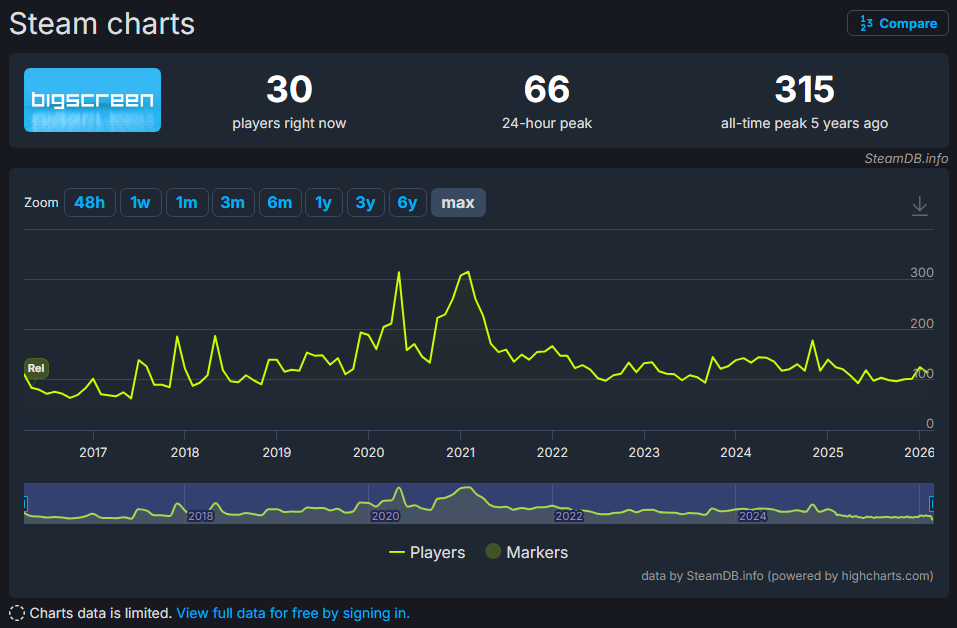
Whereas VRChat recently achieved an all-time peak concurrent user count of 79,583 on Steam, Bigscreen’s peak came in 2021 with 315. Today 24-hour peaks are lucky to hit 100.
Quest numbers are harder to infer. Bigscreen Beta currently does not feature in the top 50 most popular apps on the Horizon Store. They do, however, have 5.8 thousand lifetime reviews since their May 2019 release, which doesn’t sound too shabby. Until you check the review counts for Rec Room and VRChat, boasting 37 thousand and 35 thousand respectively.
Given the app is best known for users illicitly streaming copyrighted material, maybe the apparent lack of attention from its developer is due to potential liability. Maybe it’s best if the app remains off the radar of litigious rights holders.
It can actually be refreshing popping into an app where the same hundreds of users congregate. You start to see some familiar faces, streamlining the process of finding a welcoming room to watch videos or chat.
Bigscreen lacks an integrated groups or communities feature, but its Discord does feature a channel to promote separate community Discords. These usually coordinate film screenings around certain themes or genres. This is a viable option for users wanting some kind of organization to hop into, rather than going it alone.
With sparse development updates and flat user growth, it’s hard to envision how Bigscreen might have serious upside, even with its 10-year anniversary around the corner in late April. Still, it’s a fixture of the VR landscape, often featuring in listicles and YouTube videos recommending must-try apps for new users.
But with competition from and Bigscreen’s own collaboration with VRChat, not to mention the possibility of future system-level co-watching experiences from Meta, Apple and Google on their respective operating systems, it’s hard to imagine Bigscreen growing beyond its current modest trappings.
For the sake of its users and communities that have emerged organically within the walls of its virtual theaters, hopefully it can keep trucking along toward its 10th anniversary and beyond.